The Empty Wall
Two years of people queuing to look at nothing, the Budget on one page, and last week’s answer.

This week
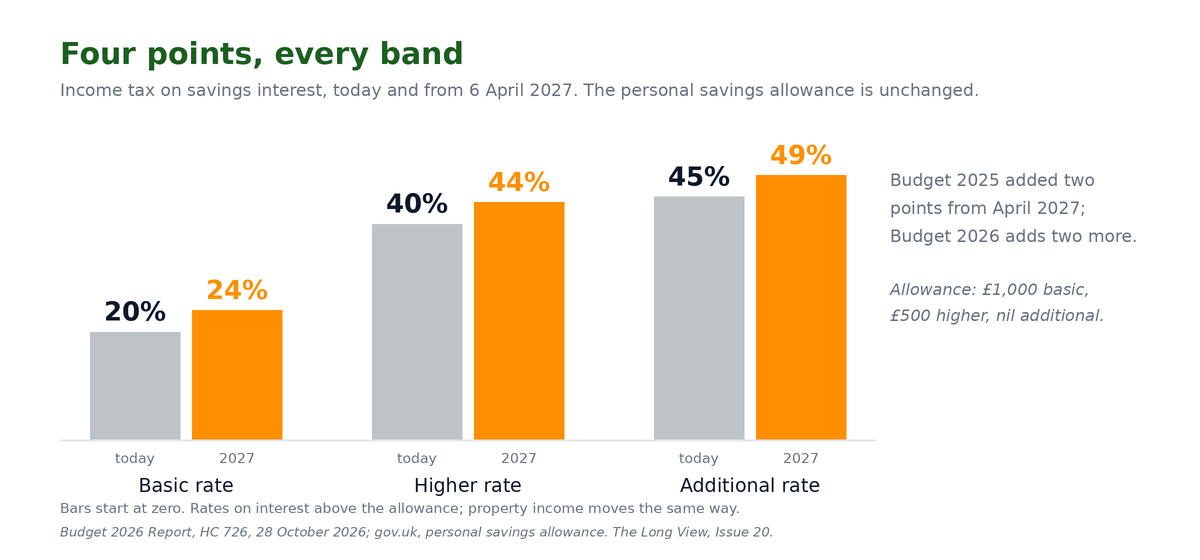
The Budget, from the documents. Four things moved for anyone with savings or a pension. Tax on savings interest goes up by four points from April 2027, two legislated last year and two more now: 24% at the basic rate, 44% higher, 49% additional. The cash ISA cut to £12,000 is dropped; the limit stays at £20,000 for everyone. The state pension’s triple lock runs unchanged to April 2029, so next April’s 3.9% stands; from April 2030 it is adjusted so that the pension tracks earnings rather than ratcheting above them. And the two-year rule on tax-free pension death benefits is gone for payments from 28 October.1
What did not move. Capital gains tax at 18% and 24% with the £3,000 exempt amount; the £500 dividend allowance and the dividend rates; the £268,275 pension lump sum cap; pensions coming inside inheritance tax from April 2027; the income tax thresholds, frozen to April 2031.1
One loose end. The regulations already made for April 2027 carry the cash ISA cut and, with it, a 22% charge on interest from cash held in a stocks and shares ISA.2 The Report drops the cut and says nothing about the charge; the press reports it goes too, and HMRC has not yet published the paper that would revoke it. The diary below keeps the line until it does. What it means for you: if you hold cash inside a stocks and shares ISA, nothing changes until the regulations do.

One number
44. The rate of tax on savings interest for a higher-rate taxpayer from 6 April 2027, up from 40% today. The first £500 of interest is still untaxed under the personal savings allowance; above it, £700 of interest costs £308 in 2027/28 against £280 now. What it means for you: for cash outside an ISA, the rate has moved whilst the allowance hasn’t.13
The question
Last week’s answer. £10,000 of the same fund, held for a year and sold, on a platform charging £6.95 a deal and 0.35% a year on exchange-listed holdings. The sterling line: £6.95 in, £6.95 out, £35 for the year, £48.90 in all. The dollar line adds the 0.99% currency charge each way, £99 in and £99 out: £246.90 in total. Same fund, same year; the difference is which line you bought.4
This week’s question. A higher-rate taxpayer holds £20,000 in a savings account outside an ISA at 4%. Using the new rates and the unchanged personal savings allowance, how much more tax do they pay in 2027/28 than in 2026/27? Reply with your figure, or answer with one click below. The working is in next week’s edition.
The long read: The empty wall
I went to Paris on Saturday to enjoy a cultural weekend. An opportunity to see the Mona Lisa, perhaps? If you have ever tried to visit her, you already know how the trip goes. You shuffle into a packed room, crane your neck over a sea of raised smartphones, and catch a glimpse of a surprisingly small piece of wood behind bulletproof glass. You are essentially looking at a crowd looking at a painting.
On Saturday, the Louvre was closed, so I didn’t even get that far. Instead, I stood outside and saw what Paris saw for more than two years from 1911: nothing, and a great many people looking at it.
It’s easy to assume the Mona Lisa draws the biggest crowd in the world simply because it’s the greatest painting in the world. In reality, that crowd is the result of a century-old feedback loop.
On Monday 21 August 1911, a day the museum was shut to the public, a man who’d worked there walked out with the painting under his coat. Nobody noticed until the Tuesday. For twenty-eight months it was gone, and in that time something happened to it that no restorer could have achieved.
Before the theft, the painting was admired by people who knew about paintings. It wasn’t however a painting that everyone could name. The newspapers made it that. The theft ran on front pages for weeks. The police questioned Picasso and visitors came to the Salon Carré to look at four empty hooks and the space between them. People queued to see where a painting was not.
It was finally recovered in Florence in December 1913, after the thief tried to sell it to a dealer. It returned to the Louvre at the start of 1914, to crowds larger than it had ever drawn. The artistry hadn’t changed. The attention had, and the attention became the thing people travelled to see. Fame had begun feeding on itself.
Once you see how that crowd formed in Paris, you realise that a fund that holds a market by size does the exact same thing with your money.
When you buy a market-cap weighted index fund, nobody at the fund sits down to decide which companies matter. Instead, the fund follows the crowd. Every day, money moves toward the companies people are talking about. As their share prices rise, their weight in the fund automatically rises with them. The fund holds more of a company because it is talked about, and it is talked about because the fund, and every fund like it, is forced to hold more of it.
By the file dated 20 October, the ten largest holdings in the S&P 500 fund we have followed since Issue 17 make up 38.4% of the entire box.5 They are the ten companies you’d stand a good chance of naming without looking, and that isn’t a coincidence. This is the mechanism. Attention is built into the weights. Just like the Mona Lisa, the company at the top of the list takes up the most space because the queue says it should, right up until the queue gets distracted somewhere else.
What to do with that is your question, not ours. What the figure tells you is that a tracker is not a neutral list of 500 companies. It is a map of where attention was yesterday, drawn to scale. Knowing that is most of what there is to know about why the top of every major fund looks the same, and why buying “the whole market” often means standing in the exact same room as everyone else.

Diary
- 28 October 2026 The Budget: savings rates, the cash ISA, the triple lock and pension death benefits, above.
- 6 April 2027
- Unused pensions come inside inheritance tax.
- Tax on savings interest rises to 24%, 44% and 49%.
- The cash ISA limit stays at £20,000; the 22% charge on cash interest in stocks and shares ISAs, in regulations already made, is expected to be revoked; confirmation awaited.
- A Pension Tax Allowance for pensioners with income up to the full new state pension, to April 2030.
- 8 June 2027 New fund disclosure rules become mandatory.
- Late 2027 Securities Transfer Tax replaces stamp duty on shares.
- 6 April 2028 The earliest age to draw a pension rises to 57.
- 6 April 2029 Salary sacrifice above £2,000 starts to attract national insurance.
- April 2030 The state pension triple lock is adjusted.
- 5 April 2031 The inheritance tax threshold freeze ends; income tax thresholds are frozen to the same date.
Reply with your answer, or with anything you spotted this week that should have been here.
Where the figures come from
- HM Treasury, Budget 2026 Report (HC 726), 28 October 2026: savings income rates, para 6.247; cash ISA limit, para 2.52; triple lock, para 5.23 and Box 5.A; lump sum death benefits, para 6.243; Pension Tax Allowance, para 6.182; Securities Transfer Tax, para 6.179. Items not mentioned in the Report are listed as unchanged.
- The Individual Savings Account (Amendment) (No. 2) Regulations 2026, SI 2026/1018, and HMRC, Reduction in the cash ISA limit, tax information and impact note, 17 September 2026; both unamended on gov.uk at 29 October 2026.
- gov.uk, Tax on savings interest: personal savings allowance £1,000 at the basic rate, £500 at the higher rate, nil at the additional rate, 2026/27.
- Last week’s question: Hargreaves Lansdown charges page, read 3 August 2026 (dealing £6.95; 0.35% a year; currency charge 0.99% on the first £10,000); the fund’s value taken as flat for the year.
- iShares, holdings file for iShares Core S&P 500 UCITS ETF, holdings as at 20 October 2026: ten largest holdings 38.37%.
Diary: Finance Act 2026; SI 2026/1018; FCA PS25/20; Budget 2026 Report. Nothing here is a recommendation.
The Long View is written by Allocra. If you hold funds outside an ISA or pension, Allocra works out figures like the one above, what each holding costs at the platform’s own tariff, the reporting status, the excess reportable income and the gains, for the funds you actually hold, from your own records. allocra.co