Top-Heavy
A warship that sailed for twenty minutes, the number 22, and last week’s answer.

This week
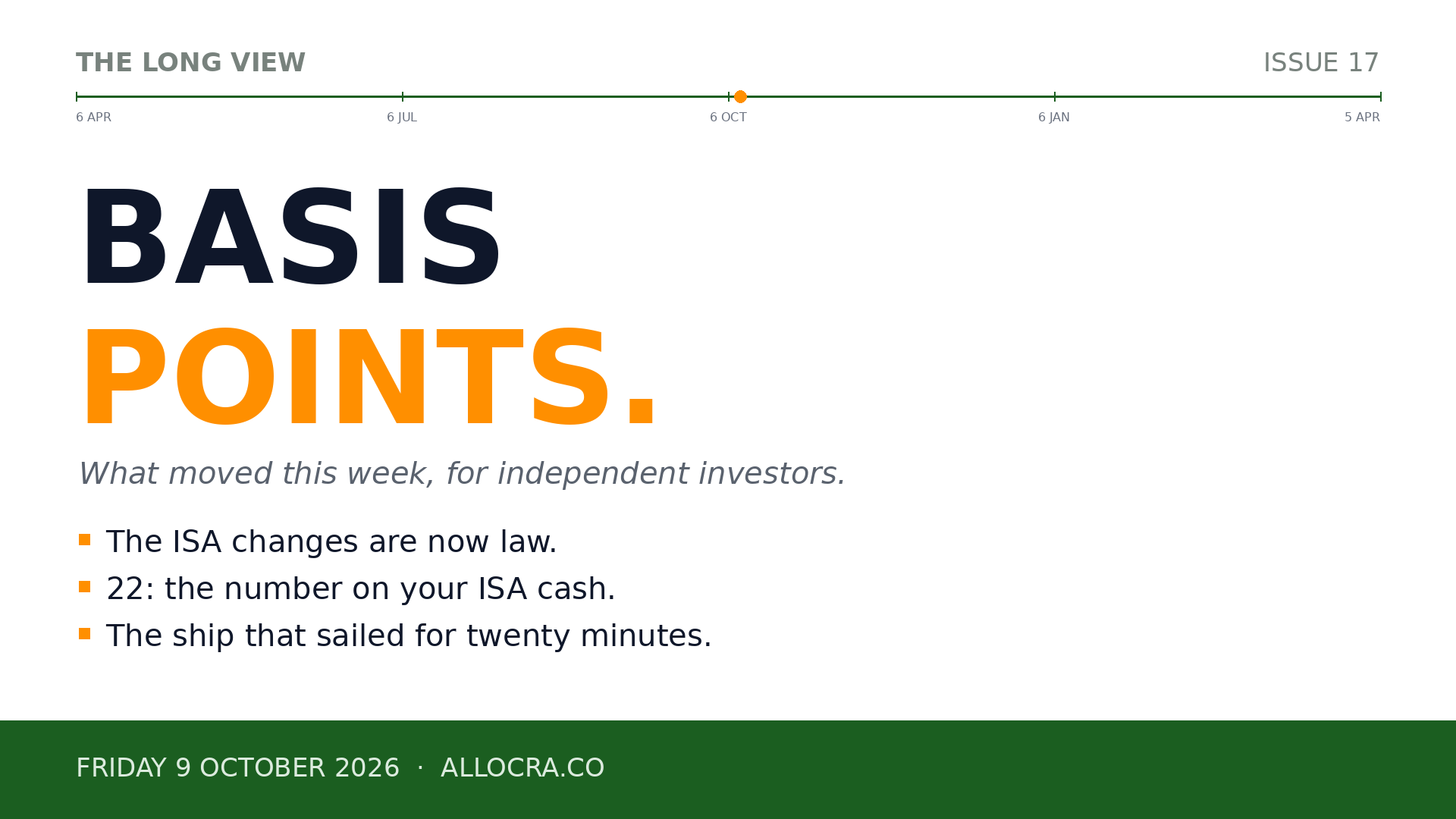
The ISA changes are now law. The Individual Savings Account (Amendment) (No. 2) Regulations 2026 were made on 10 September, laid before the Commons on 14 September, and come into force on 6 April 2027.1 They put in statute what the Budget announced last November: a £12,000 cash ISA limit for anyone 64 or under at the end of the tax year, a flat 22% charge on interest paid on cash held inside a stocks and shares or Innovative Finance ISA, no transfers from a stocks and shares ISA into a cash ISA, and one rule that has had almost no coverage: a stocks and shares ISA made up entirely of money market funds becomes a non-qualifying investment. Shares, funds, ETFs and gilts are not treated as cash-like; a money market fund held alongside them is fine.2 What it means for you: from April 2027 a stocks and shares ISA is for investments and a cash ISA is for cash, by law, and cash that lives in the wrong one pays. The charge is collected by the ISA manager; there is nothing to declare.
HMRC’s list is still the September one. The reporting funds list that decides whether a gain outside an ISA or pension is taxed as a capital gain or as income is still dated 4 September.3 Last week we said October’s was due any day; it has not come. Over the past year the update has landed between the 3rd and the 14th, so it may be days away. What it means for you: a fund that launched this summer should be checked against the October edition when it appears, not this one.
Three weeks to the Budget. Wednesday 28 October.4 The changes in the diary below are law or stated policy; the ISA regulations above moved from the second column to the first this month. Anything else you read before the day is speculation. What it means for you: the allowances for this tax year are what they are today, and decisions made on rumours tend to be the expensive ones.

One number
22. The percentage charged, from 6 April 2027, on interest earned by cash held inside a stocks and shares ISA.1 Not the cash ISA: the uninvested balance in the investment one, the dividends waiting to be reinvested, the money parked while you decide. So what: £5,000 at 4% earns £200 a year, and from April 2027 the charge on it is £44, taken by the ISA manager before you see it. The same £5,000 in a cash ISA pays nothing. For nearly thirty years the two wrappers were interchangeable places to hold cash; from April 2027 they are not, and the difference has a number.
The question
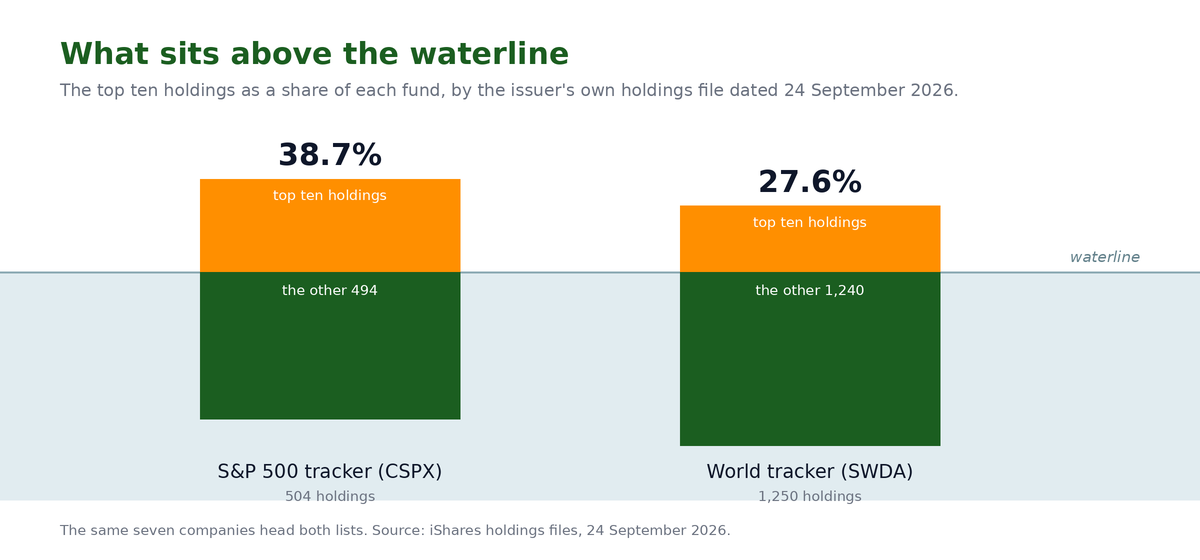
Last week’s answer. The fund with 1,250 companies is iShares Core MSCI World (SWDA); the one with 504 is iShares Core S&P 500 (CSPX). By the issuer’s own holdings files dated 24 September 2026, the S&P 500 fund has 38.7% of its money in its top ten companies; the world fund has 27.6%.5 The fund with two and a half times as many holdings is eleven points less concentrated at the top, and the same seven companies head both lists. More holdings doesn’t mean less concentration in proportion; it means a longer tail behind the same head.
This week’s question. Two funds track the same index. One charges 0.07% a year, the other 0.20%. You put £50,000 in each and leave it for twenty years, and the index returns 5% a year before charges. How far apart do the two pots finish? Reply with your answer; the figures, from the published formula, are in next week’s issue.
The long read: The ship that sailed for twenty minutes
On Sunday 10 August 1628 the most powerful warship in the Baltic cast off from below the royal palace in Stockholm. The quay was packed. Small boats crowded the water to watch. The crew had been allowed to bring their families aboard for the first leg. Four of the ten sails were set, a salute was fired, and the Vasa drifted on the current into the harbour. Ordered by King Gustav Adolf of Sweden to project naval power, it boasted two enclosed gundecks carrying 64 bronze cannons. It was an ornate and majestic looking ship.6
There was almost no wind on that maiden voyage. A small gust filled the sails and the ship heeled to port, then slowly came back. A stronger gust followed as she cleared the gap in the cliffs. This time she went over far enough for water to pour in through the open gunports on the lower deck, and she did not come back. Within minutes the Vasa was on the bottom in 32 metres of water, her masts sticking up above the surface with people clinging to them. About thirty of those aboard died. She had been under sail for roughly twenty minutes.
The ship was not badly built. Her designer, Henrik Hybertsson, was an experienced master shipwright who had delivered good warships to the Swedish Crown before. The problem was proportion. The Vasa was something new in size and armament. Simply put, the ship was built too tall and too narrow. Her upper works, the decks and gun platforms above the waterline, were built tall and heavy. The hull beneath them was comparatively small. The ship lacked the necessary ballast to support the magnificent sight visible above the waterline. It looked invincible yet required only a light breeze to bring it down.
The remarkable part is that people knew. A few weeks before she sailed, Admiral Fleming had the ship tested where she lay below the palace. Thirty men were made to run together from one side of the upper deck to the other, and back, to set her rolling. After a few crossings he stopped them; the roll was so alarming that he feared she would go over at her moorings. Those standing nearby saw it. The king was away at war in Poland and had been pressing for the ship to sail. Nobody dared tell him the truth.7
So she sailed, with her gunports open for the salute, and twenty minutes later she was gone. The open ports let the water in under a light wind. She stayed on the harbour floor for 333 years, until she was raised, almost whole, in 1961. You can stand next to her in Stockholm today. She is enormous, and ornate, and looks magnificent. The flaw was never visible from the side. It was in the ratio between what was above the water and what was below it.
That ratio has striking parallels. Most things that fail suddenly after looking strong for a long time fail the same way. Weight accumulates up top, by increments that each seem reasonable, until the thing that held it all steady is small in proportion. The Vasa did not become top-heavy on the day she sank. She became top-heavy one plank and bronze cannon at a time. A multitude of decisions, none of which was the fatal one, while she sat upright in the harbour and everybody admired her.
Last week’s number was seven: seven companies that made up a fifth of one broad tracker and over a third of another. This week’s answer is that a fund with 504 companies carries 38.7% of its weight in ten of them. None of that is a prediction, and none of it is a verdict on those companies, which are among the most profitable enterprises ever built. It is a proportion. The question the Vasa asks of any structure, a ship or a portfolio or anything else that is meant to stay upright in a sudden gust of wind, is not whether the heavy things at the top are good. It is how much ballast is below the waterline to balance them, and whether anyone has run thirty men across the deck lately to find out.
Admiral Fleming’s test cost nothing and took an afternoon. He ran it, saw the answer, and stopped before the ship went over. Then the ship sailed anyway, because the answer was unwelcome and the person who needed to hear it was far away and focused on a different answer. The test was not the failure. The failure was what happened to the result.
The Vasa did eventually rise again, after 333 years. Not every sinking has that ending, no matter how long you wait.

Diary
- 28 October 2026 The Budget.
- 6 April 2027
- Unused pensions come inside inheritance tax.
- Savings income tax rates rise by two points.
- The £12,000 cash ISA limit for under-65s.
- The 22% charge on cash interest in stocks and shares and Innovative Finance ISAs, and the money market fund rule, come into force (SI 2026/1018).
- 8 June 2027 New fund disclosure rules become mandatory.
- 6 April 2028 The earliest age to draw a pension rises to 57.
- 6 April 2029 Salary sacrifice above £2,000 starts to attract national insurance.
- 5 April 2031 The inheritance tax threshold freeze ends.
Reply with your answer, or with anything you spotted this week that should have been here.
Where the figures come from
- The Individual Savings Account (Amendment) (No. 2) Regulations 2026, SI 2026/1018, made 10 September 2026, laid before the House of Commons 14 September 2026, in force 6 April 2027. legislation.gov.uk.
- HM Revenue and Customs, ISA reform 2027: anti-circumvention rules factsheet, published 23 June 2026, updated 30 September 2026. gov.uk.
- HM Revenue and Customs, Approved offshore reporting funds, list dated 4 September 2026; page checked 8 October 2026 (last updated 9 September 2026).
- HM Treasury, the Chancellor’s letter to the Treasury Select Committee, 31 July 2026, setting the Budget date.
- iShares holdings files for iShares Core MSCI World UCITS ETF (IE00B4L5Y983, 1,250 holdings, top ten 27.6%) and iShares Core S&P 500 UCITS ETF (IE00B5BMR087, 504 holdings, top ten 38.7%), both dated 24 September 2026.
- The Vasa Museum (Statens maritima och transporthistoriska museer), The Disaster and Vasa, machine of war, vasamuseet.se, checked 7 and 8 October 2026: the sailing, the sinking, the depth, the dead, the 64 guns and the designer.
- The Vasa Museum, Fact and fiction, the museum’s account of the surviving sources including the inquiry transcripts: Admiral Fleming’s test with thirty men, and the salvage of 1961. vasamuseet.se, checked 7 October 2026.
Diary: Finance Act 2026; SI 2026/1018; FCA PS25/20. No product is mentioned in this issue and nothing here is a recommendation.