The $6 Million Handshake
For a decade, an industry marketed itself on a magazine’s rankings. Then the magazine fired its editor over a secret payment from the ranker. This week’s letter is about what a badge is worth when you cannot see who paid for the iron.
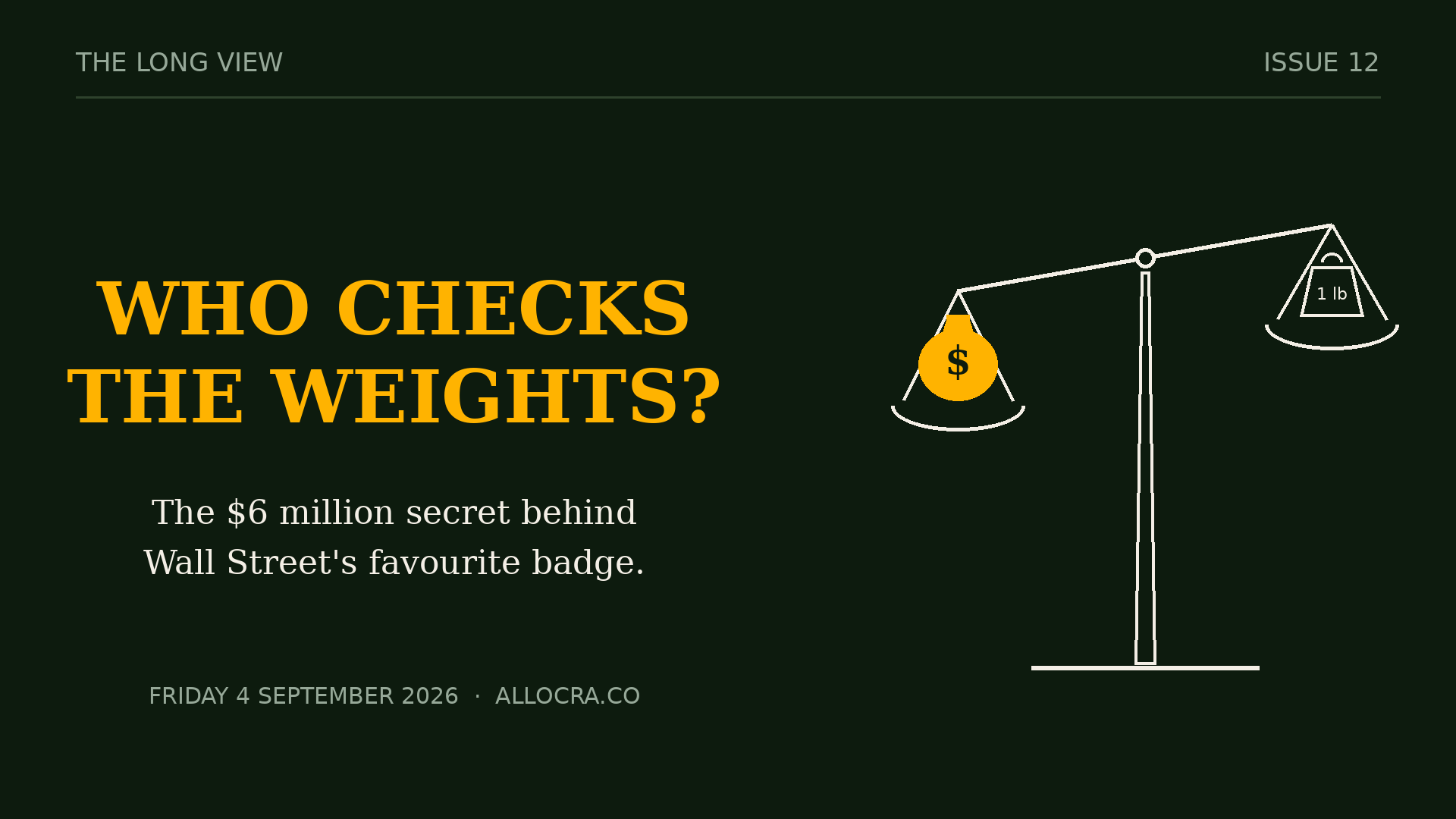

The Keeper of the Weights
In the merchant markets of medieval Europe, one official mattered more than any trader: the Keeper of the Weights. He held the master irons against which every merchant’s scales were checked. A stall bearing the Keeper’s stamp meant a pound of grain was a pound of grain. The whole market’s trust ran through one man and one set of weights.
Which raises the old question: what happens if someone quietly pays the Keeper?
For the modern wealth management industry, one master weight has been the Forbes Top Wealth Advisors ranking, produced with Shook Research since 2016. Advisers put the badge on their websites, their brochures, their conference biographies. It signalled the same thing the Keeper’s stamp once did: this one has been checked.
In July, Forbes quietly parted with Randall Lane, its chief content officer and top editor of nearly a decade. On 12 August the New York Times reported why: Lane had accepted a secret payment of six million dollars from RJ Shook, founder of the research firm behind the rankings, made after Shook sold a majority stake in his company to private equity. Forbes staff learned the reason their own editor was fired by reading the Times.
Nine days later, Morgan Stanley, one of the largest wealth managers in the world, suspended its participation in the rankings by internal memo: no more badges in marketing, no more conferences. The master weight had been withdrawn from the market.
The Business of Badges
Be precise about what has and has not been shown, because the precision is the lesson. Nobody has demonstrated that a single ranking was altered. Lane called the money a personal gift for years of advice, and said plainly: ‘I made a mistake, and I take responsibility for it. I should have disclosed the gift and failing to was a serious error in judgment.’ Shook Research says the payment did not come from the company.
But for everyday investors, that is entirely beside the point. A badge’s entire value relies on the belief that it is 100% objective.
Six million invisible dollars passing between a ranker and a publisher doesn’t need to change a list to destroy it. It prices the badge at zero because the badge only had value if the public believed no such payment could exist.
To understand how this happens, it helps to understand how industry accolades actually work. Rankings and awards are not public services; they are businesses. Here is how the money flows:
The Revenue: Money is made through licensing fees (winners pay for the right to put the badge on their website) and exclusive conferences.
The Customer: The financial advisor being ranked is the actual paying customer.
The Product: The everyday investor reading the ranking is just the audience being sold.
Once you see whose money flows where, the surprise isn’t that trust finally broke; it is how long it held together.

Do the Badges Even Work?
The deeper question is whether the badges ever measured anything. Here the evidence predates the scandal, and some of it comes from the badge-makers themselves.
In 2010, Morningstar’s own director of fund research tested whether its famous star ratings predicted future fund performance, against a boring alternative: just picking funds with the lowest fees.
The low fees won. Cheap funds beat expensive ones in every asset class over every period tested, while five-star funds beat one-star funds in only 13 of 20 tests. Morningstar’s raw data beat Morningstar’s badge. To their credit, they published that.
The UK ran a harsher experiment. Neil Woodford’s Equity Income fund sat on Hargreaves Lansdown’s Wealth 50, the country’s most influential best-buy list, right up until 3 June 2019, the day the fund suspended dealing and trapped its investors. It was removed from the list the day after; the money was removed from reach for years.
Years later the regulator moved to fine Woodford and his firm a combined £46 million over the fund’s failures, decisions both are contesting at the Upper Tribunal. The list was not corrupt. It did not need to be. It just was not the safeguard its readers believed it was, and the difference between those two things was invisible until the day it mattered.
The workings: where the numbers come from
Lane’s departure was confirmed by an internal Forbes email dated 23 July (AP via the Guardian, 13 August 2026); the six million dollar payment was reported by the New York Times on 12 August; Lane’s quote is as reproduced by the Guardian; Shook Research’s statements are via ThinkAdvisor, 13 August; the Forbes and Shook partnership dates from 2016 (Guardian). The Morgan Stanley suspension memo: AdvisorHub and ThinkAdvisor, 21 August. The Morningstar study: Russel Kinnel, How Expense Ratios and Star Ratings Predict Success, 2010, morningstar.com; low expenses beat the star rating in every asset class over every period tested, while stars predicted in 13 of 20 tests. Woodford: dealing suspended 3 June 2019, removed from the Wealth 50 on 4 June (Citywire, Professional Adviser, Funds Europe); in August 2025 the regulator moved to fine Neil Woodford and Woodford Investment Management a combined £46 million, decisions both are contesting at the Upper Tribunal. The medieval weights framing is archetypal (the assize of weights and measures), stated as history with no specific claim. Every claim dated; where we cannot verify, we show a dash rather than a guess.

The Public Weights
Medieval markets did eventually solve the Keeper problem, and not by finding more honest Keepers. They chained standard weights in the public square. Any merchant, any customer, could walk over and test a scale themselves. Trust moved from a man to a method anyone could check.
For the self-directed investor, this is the ultimate lesson. True financial clarity doesn’t ask for your blind faith. It survives a secret handshake because there is nothing a handshake can buy.
A fund’s published list of investments can be read.
An expense fee is a mathematical fact.
A company’s actual performance data can be verified.
The things that require trust in a gatekeeper (the badge, the ranking, the award, the best-buy list) are precisely the things a hidden payment can hollow out without leaving a mark.
So the working rule for a self-directed investor is old and short: trust what shows its workings. Treat every medallion as marketing until proven otherwise, not because the people behind them are corrupt, but because you have no way of knowing. When you learn to read the published data, you don’t have to.
A badge asks for your trust. A published methodology lets you test it. Only one of those survives a secret handshake.