How to Be Paid With Your Own Money
It was your own coat, handed back on the way out.

The Story
Cast your mind back to your youth. Do you remember your parents opening the morning post and pulling out a crisp, official looking piece of paper: a dividend cheque?
It felt like a little ceremony, as they opened the envelope together. Every quarter, regular as clockwork, the post delivered maybe fifty, a hundred pounds, sometimes a little more. Free money. A reward from the universe, just for owning a tiny slice of a company. The sum varied, nothing life changing, but something towards the family holiday.
Except that money was never actually a gift.
It helps to remember why the envelope existed at all. In those days, the cheque was the only practical way to be paid by your investments. Selling shares meant a stockbroker, a telephone call, a fee, and a fortnight’s wait for the paperwork. Nobody sold three shares to fund a holiday. So income arrived by post, on schedule, and the ritual had a real reason.
Then the screens arrived. Selling became a button. The stockbroker, the phone call and the fortnight all vanished, and the reason for the envelope vanished with them. But rituals outlive their reasons. That is what rituals do. Most of us inherited the envelope without ever being told why it was there.
Here is the whole mechanism, and you can hold it in one hand.
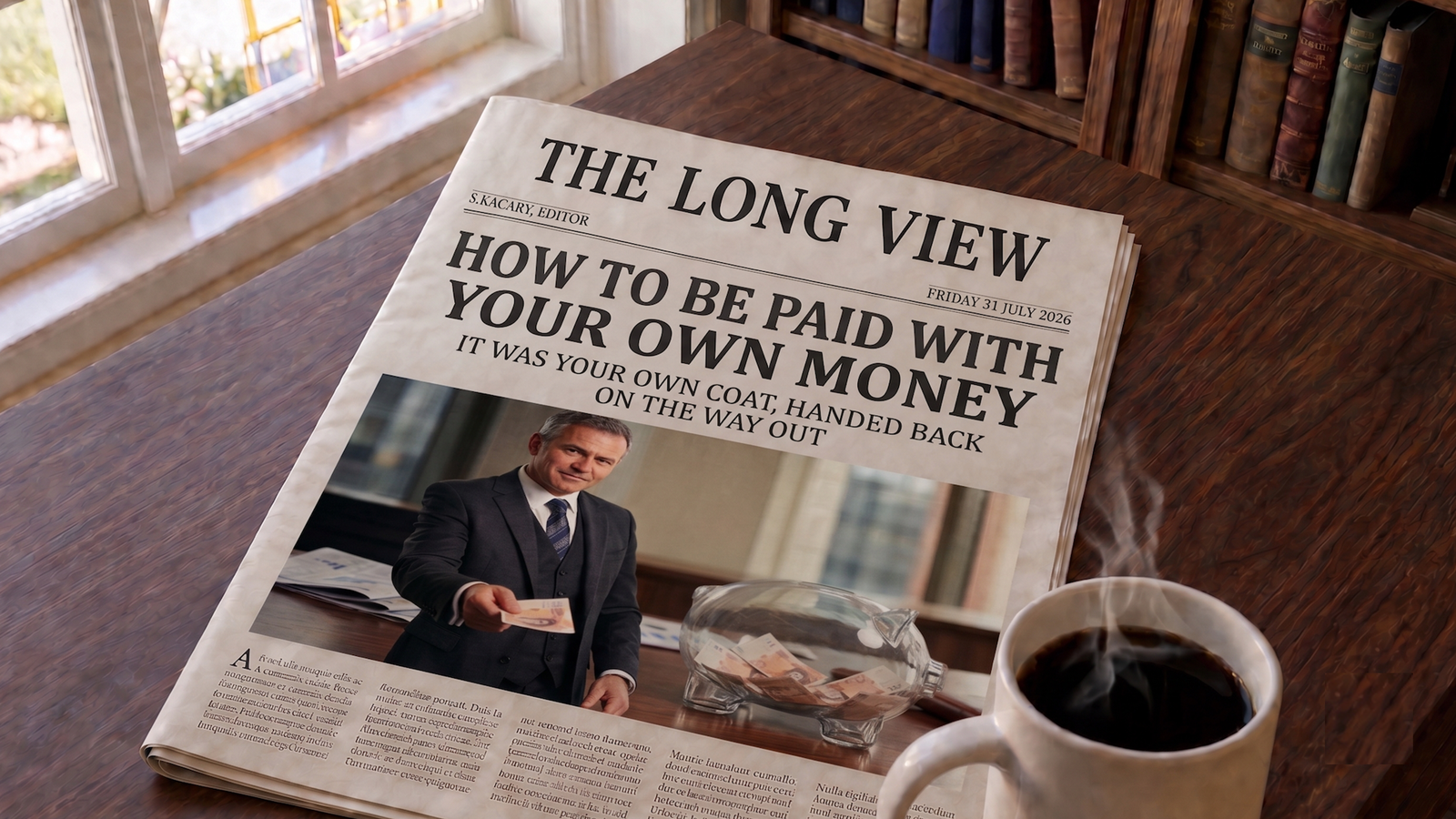
To see why, imagine a single share of a company is like a piggy bank.
Inside that piggy bank is £100 worth of company value.
Now, the board of directors sits down and says: ‘Let’s pay a £10 dividend per share!’
They reach into your piggy bank, pull out a £10 note, and pop it into an envelope addressed to you.
The moment that £10 note leaves the piggy bank, the piggy bank is worth £90.
You did not gain £10 of new wealth. You moved £10 out of your left pocket, where it sat as company equity, and into your right pocket as cash. Sometimes a fee was charged at the border, in tax. And this is not a metaphor the market indulges politely: on the morning a share goes ‘ex-dividend’ (meaning the upcoming dividend no longer belongs to the buyer) , its price is marked down by the value of the payment, often to the penny, before the usual daily ups and downs kick in.
Nothing arrived. Money moved from your left pocket to your right.
A stage magician asks to borrow your watch. He wraps it in a handkerchief, vanishes it, builds the tension, and then presents it back to a standing ovation. You applaud hardest of all. It was your watch.
Two finance researchers, Hartzmark and Solomon, went through trading records and found that investors treat dividends and price moves as if they lived in separate accounts. They called it the free dividends fallacy. The payout is treated as income that appeared from nowhere, the markdown goes unnoticed, and the cash is rarely reinvested in the fund that paid it. And when interest rates fall and savers go hunting for something that feels like interest, the demand for dividend payers rises, which means people pay a premium for the shares that perform the ceremony best. Paying for the best seats, to have your watch vanish.
Not at all. And this is the part of the piece that matters most.
Income as a plan is legitimate. If you need cash every quarter, wanting it delivered on schedule, without decisions, without having to sell anything in a bad week, is completely rational. It is annuity thinking, and it is a fine way to run a retirement. There is also a fair word to say for the companies themselves: a board that must find real cash every quarter is a board that finds discipline.
The target is the illusion, because the illusion has a price. Believing the payout is free money leads people to chase the biggest payouts, and the biggest payouts cluster in a handful of slow growing sectors. That is how a portfolio built for safety quietly becomes a concentration bet.
And living off payouts is not a safer version of selling units. It is a different contract. If you sell units for income, your risk is running out of units in a long bad market. If you live off natural yield, you can never run out of units, and in exchange your income takes the weather instead: in the financial crisis, the payouts of the five hundred biggest American companies fell by roughly a quarter and took four years to recover. In 2020, UK dividends fell by forty four percent in a single year, twice as deep, because UK dividends lean on a handful of giant payers, and when regulators paused the banks and the oil majors cut, that was most of the cheque. Neither contract is free. The honest question is never which one is safe. It is which failure you would rather live with, and how big the payout has to be before you have stopped diversifying and started betting.
So no, dividends are not bad. Just remember what the envelope is. The next time a payout lands in your account, it is not free money falling from the sky. It is your investment giving you a high five, and quietly handing you your own coat on the way out.

Hype Watch · The Income Aisle
The fastest-growing shelf in the ETF shop is ‘premium income’: funds that sell options against their holdings and pay the proceeds out monthly. The largest of them now manages about $45 billion and quoted an 8.38% distribution at the end of June. The hype is carried by one word: income. Option premium is not interest. It is the price of selling away part of your upside, handed to you as cash, and a payout is not a return. Some investors want exactly that trade, eyes open, and that is fine. After this week’s story, you know the question to ask: which pocket did it come from?

The Closer
The number the illusion inflates is the headline yield. The number that survives contact with reality is what reaches you after withholding tax, which is why our Screener shows the net figure, and why the ‘Optimiser’ will build you an income book if income is your plan, while showing you the workings of every choice.
The first 250 subscribers lock Founders pricing, £9 a month or £79 a year, for as long as their subscription stays continuous.
But no tool, ours included, will ever tell you whether you need income. It can only tell you what the income costs. The envelope is yours to keep or to retire. Just open it knowing whose money is inside.
Just open the envelope knowing whose money is inside.
What does your income actually cost? →Forward this issue to one investor who looks forward to dividend day.
The Long View is general educational content for UK and US self-directed investors. It is not investment, tax, financial, or any other form of regulated advice. Allocra Ltd is not authorised or regulated by the Financial Conduct Authority. Past performance is not a guide to future returns.
Issue 7 of The Long View. Published 31 July 2026. Previous: Issue 6, Did Sir Isaac Newton Get Hit by Gravity?. Figures in this issue: Hartzmark & Solomon, The Dividend Disconnect, Journal of Finance 74(5), 2019; Link Group UK Dividend Monitor, 2020; JPMorgan JEPI factsheet, 30 June 2026. Workings: allocra.co/methodology. Forward this issue to one self-directed investor friend.
allocra
Cut the noise. Cut the fees.